
There was no doubt in my mind that I was going to survive my cancer diagnosis. After all, my doctor had exected to cure my cancer. So when the same doctor told me the devastating news that they had gotten their original diagnosis wrong and that a cure wasn’t possible I felt… I felt what. How do you even begin to make sense of something like that.
Ultimately the way I made sense of it was by deciding that:
if I was going to die, I was going to live well
Which, other than being a great bumper sticker, meant, now more than ever, I was going to live each day as well as I could for as long as I could. Certainly more than the months they had given me.
The simple truth of the matter though is that I didn’t want to die. I can recall several times in my life when I had (wanted to die) but I was as happy as I’d ever been and I was determined not to let anything, even a terminal cancer diagnosis, change that. I had completed three cycles of intense BEP chemotherapy which had left me bald, sick and exhausted but, not for the last time, I said (doing my best braveheart impression):
cancer might take my body, but it will never take my spirit
I actually said that. I also set my first challenge. Live longer than 3 months.
Without hesitation I signed the consent form agreeing to further chemotherapy treatment (CAPOX), this time involving a combination of ‘Capecitabine’ and ‘Oxaliplatin’. These are the drugs I should have had since the start and I genuinely believe, based on conversations I’ve had with doctors since, that the only reason I was still alive was because the original chemotherapy involved ‘Cisplatin’, a drug very similar to ‘Oxyliplatin’.
Realistically I’ll never really know how close I came to death but I sure was grateful to be alive. Chemotherapy had gotten me there, there’s no doubt in my mind about that, but now I knew that it wasn’t going to be enough on its own.
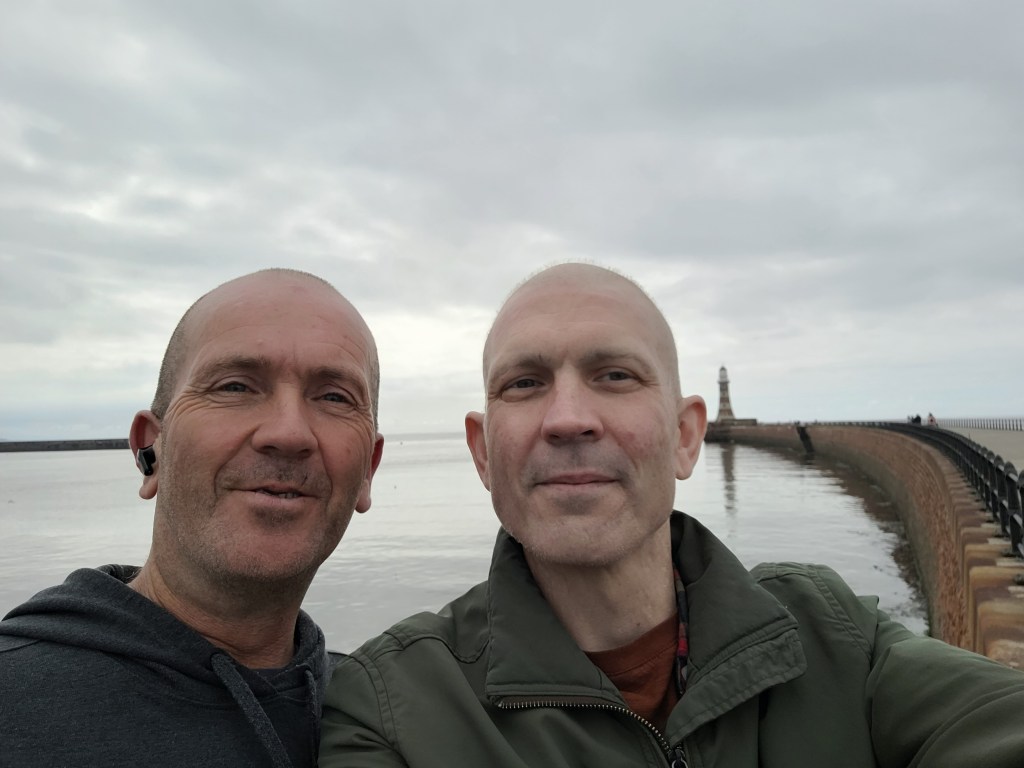
Me and my brother in Roker, Sunderland. Photo taken 16 August 2023. Only one of us was having chemotherapy!
There was one other thing that stood out on this form more than anything else. Not just so much as stood out but stood out and poked you right in the eye – The intended benefit of the previous course of treatment was curative – to give me the best possible chance of being cured. The intended benefit of this chemotherapy was not to cure. Not to cure. No cure. Even today, my throat sometimes catches when I think of those two little words. How can a life be determined by six letters. It just goes around in your head until it drives you crazy. This chemotherapy was palliative.
I’ve always thought that anything is possible though and I immediately began researching terminal cancer cases; reading studies, medical journals, blogs, articles… anything I could find. It didn’t matter if it was written by a health professional a cancer patient – or a chicken. I absorbed it all and, whilst I make no promises to you, I will say that if you, or someone you love, receives a diagnosis of stage 4 or advanced cancer; I still believe there can be a lot of reasons to remain hopeful. A common misconception is that Stage 4 cancer is always terminal which is no longer necessarily true, even if the type of cancer makes a huge difference.
I’ve also always asked a lot of questions, always been inquisitive, and so I would ask my doctor “how long do I have” and “why this treatment”. We would talk about immunotherapy because I was reading so many good things about it and I knew it was something I was going to want to try. Partly because of the toxic effects of chemotherapy and partly because I genuinely think that our bodies can be our best asset when fighting cancer. Again, I need to be really clear here. I am not one of those people who advocates shunning conventional treatments. I am not an anti-vaxxer.
Immunotherapy uses the body’s immune system to fight cancer, but trying to fight it without immunotherapy would be like sending a team of untrained, unhealthy soldiers off to fight a war against the Mongol Army. My money would be on Genghis every time.
Another thing to take away from this post is that cancer is unpredictable and doctors can’t tell you how long you have to live. They will most likely be wrong around 100% of the time. Sure, they help prepare you for the worst and give you something tangible to aim for based on latest life expectancy data (which is improving all the time) but a lot of the time this is the worst case scenario and really, no one can tell you when you’re going to die – Encouragingly, a recent Department of Health press release highlighted that as many as three in four people are now surviving their cancer beyond the first year after being diagnosed.
Again, there’s a wide gap within the different cancer types but I’m coming up on two years in April!
So is it just that treatment methods have improved or is it something else? I’m a firm believer that there are many factors. Conventional treatment, for me, still offers the best chance of survival but I believe there are things we can all do, and are doing, to improve not just quality of life but also to prolong it. There seems to be a real movement (based on what I see and hear) to get people healthy again. This is important because there’s no doubt in my mind that environmental factors, stress and diet are just some of the things leading to a rise in cancers and other chronic diseases.
Initial testing on my tumour, however, identified marker patterns of an inherited tendency and features associated with an increased chance of developing certain types of cancer, particularly bowel and stomach cancer (Northern Genetics Service, Newcastle). There is also a strong history of cancer in my family. That doesn’t mean that environmental and lifestyle factors aren’t the answer for my cancer diagnosis though and, ordinarily, I don’t think I would need to know the cause but it might have implications for my family. Interestingly, only a very small percentage of cancers are inherited.
One of the first things I heard a (well known and popular) cancer survivor say was that, before anything else, you have to accept that you gave yourself cancer! I’m sorry but I just don’t agree with this and I find it potentially harmful to a person. For one, it might not be true. but also, a cancer diagnosis is already likely to cause a range of emotions that can be overwhelming and I don’t think that you should add to that.
I haven’t always led a healthy lifestyle, often driven by mental health issues, and of course there are times when I regret this but during these times I remember to show myself compassion. I need all of my energy to focus on what matters now. I can’t change what happened before but maybe I can change what happens next.
 Me, Myself and Cancer
Leave a comment